



This report compiles the latest Seedance AI statistics and performance benchmarks for 2026, covering data from official sources, independent testing platforms, and real-world generation metrics. By February 2026, Seedance 2.0 had arrived with a quad-modal input system supporting up to 12 reference files—images, videos, audio, and text prompts—in a single generation request. This analysis examines what the benchmark data actually shows: ELO rankings, success rates, generation speed metrics, and how Seedance compares to other text to video AI tools on measurable performance criteria.
Seedance AI Key Statistics ( 2026 )
- • 99.8% video generation success rate
- • 3.8 seconds average generation time
- • 90% usable output rate (vs ~20% industry average)
- • #2 global ranking (ELO 1270 in text-to-video benchmarks)
- • Up to 12 multimodal inputs supported (text, image, video, audio)
- • 2K video output capability
- • 1450% ROI increase in e-commerce marketing use cases
- • 80%+ sales uplift reported in AI-generated ad campaigns
- • 90% cost reduction vs traditional video production
- • Multi-shot scene generation in a single prompt (Seedance 2.0)
Seedance Overview: Technical Specs & Version Evolution
1 What is Seedance?
Seedance is ByteDance's proprietary AI video generator, developed by the company's Seed research division—the same team behind Doubao (ByteDance's large language model) and various other AI initiatives. The platform generates video content from text descriptions, images, or existing video clips.
Its architecture focuses on motion consistency, multi-shot scene generation, and high fidelity. According to ByteDance, Seedance 2.0 improves cinematic quality and supports advanced AI video marketing applications.
2 Seedance Version Evolution
Seedance has undergone significant iteration since its initial release:
| Version | Release Year | Key Features | Improvements |
|---|---|---|---|
| Seedance 1.0 | 2025 | Text/Image→video | 1080p output, basic motion consistency |
| Seedance 1.5 Pro | 2025 | Added audio→video | Improved audio-visual sync, scene cohesion |
| Seedance 2.0 | 2026 | Full multimodal input | Multi-shot scenes, complex action sequences, faster generation |
Data Sources: Bytedance
Seedance 2.0 marks a major shift from simple clip generation to multi-shot narrative construction, a critical factor for content creators aiming for social media and marketing-ready videos.

Data Sources: Artificial Analysis
Seedance's progression looks solid—from 1.0 Mini at 1076/1133 ELO up to 2.0 720p hitting 1270/1346, roughly a 30% jump. The fact that Image-to-Video (I2V) consistently beats Text-to-Video (T2V) across all versions is worth noting, probably because starting from a real image gives the model less to hallucinate. On the business side, the pricing data is notable: the newer 1.5 Pro is actually cheaper than the original 1.0 ($5.93 vs $7.32/min), and 2.0 has no public API yet—both data points that suggest ByteDance is still calibrating its monetization strategy.
3 Seedance Technical Specifications
Seedance offers several technical capabilities that define its position in the AI video tools landscape:
| Parameter | Specification | Details |
|---|---|---|
| Resolution | 720p/1080p/2K | 2K available for high-end deliverables |
| Video Duration | 4-15 seconds | Per single generation request |
| Max Output Length | 15 seconds | High-quality multi-shot video with audio |
| Multimodal Input | Up to 12 files | 4 types: text, images, video, audio |
| Images Input | Up to 9 images | Simultaneous reference images |
| Video Input | Up to 3 clips | Each up to 15 seconds |
| Audio Input | Up to 3 files | Each up to 15 seconds |
| Character Consistency | Excellent | Facial features, proportions, clothing across shots |
| Multi-Shot Native | Yes | 2-3 shot transitions in single 10-15s video |
| Native Audio Output | Yes | Dual-channel stereo, multi-track parallel |
| Audio Track Types | 3 types | Background music, ambient sound, voiceover |
| Lip-Sync | Accurate | Dialogue with precise mouth movement |
| Physics Simulation | Very Good | Gravity, momentum, fluid dynamics, light reflection |
| Usable Output Rate | 90%+ | Based on third-party API testing |
Data Sources: ByteDance | AtlasCloud
Seedance Performance Benchmarks
1 Internal Testing: SeedVideoBench Framework
ByteDance evaluates Seedance using the SeedVideoBench framework, measuring four core areas:
- 1️⃣ Prompt fidelity assesses how closely generated video matches the text prompt — a factor heavily influenced by how the prompt is written, as detailed in the Seedance prompting guide.
- 2️⃣ Motion realism checks for natural movement without flickering or artifacts.
- 3️⃣ Scene coherence evaluates consistency across frames.
- 4️⃣ Multi-shot reliability tests quality maintenance across longer sequences.
What do these benchmarks mean in practice? Reviews consistently mention Seedance's improved handling of physics and natural movement. When generating a walking sequence, feet contact the ground at realistic intervals. Water flows without clipping through objects. Fabric movement follows gravity and momentum patterns. These details matter—they separate genuinely usable output from content that requires extensive editing.
2 Third-Party Rankings & ELO Data
Based on the latest data from Artificial Analysis Video Arena (as of April 2026), ByteDance Seedance models demonstrate impressive competitiveness in the global text-to-video landscape:
Key Findings:
1️⃣ Seedance 2.0 (Dreamina) ranks #2 globally with an ELO score of 1,270.
2️⃣ Seedance 1.5 Pro ranks #29 with an ELO score of 1,173.
3️⃣ Seedance 1.0 ranks #35 with an ELO score of 1,137.
4️⃣ Seedance 1.0 Mini ranks #46 with an ELO score of 1,076.

Data Sources: Artificial Analysis
The ByteDance Seed team has shown remarkable progression, with Seedance 2.0 representing a significant leap from its predecessors. The model family collectively represents ByteDance's strategic investment in AI video generation. This places Seedance firmly in the top tier of AI video generation models, competing directly with top players like HappyHorse-1.0 (1362), Kling 3.0 Pro, and SkyReels V4.

Data Sources: Artificial Analysis
In the Image-to-Video (I2V) category, Seedance 2.0 achieves an ELO score of 1346, ranking #2 behind HappyHorse-1.0 (1398). The 52-point gap suggests Seedance's image understanding and animation capabilities are highly competitive in the industry.
3 Performance Data: Seedance 2.0 vs Industry
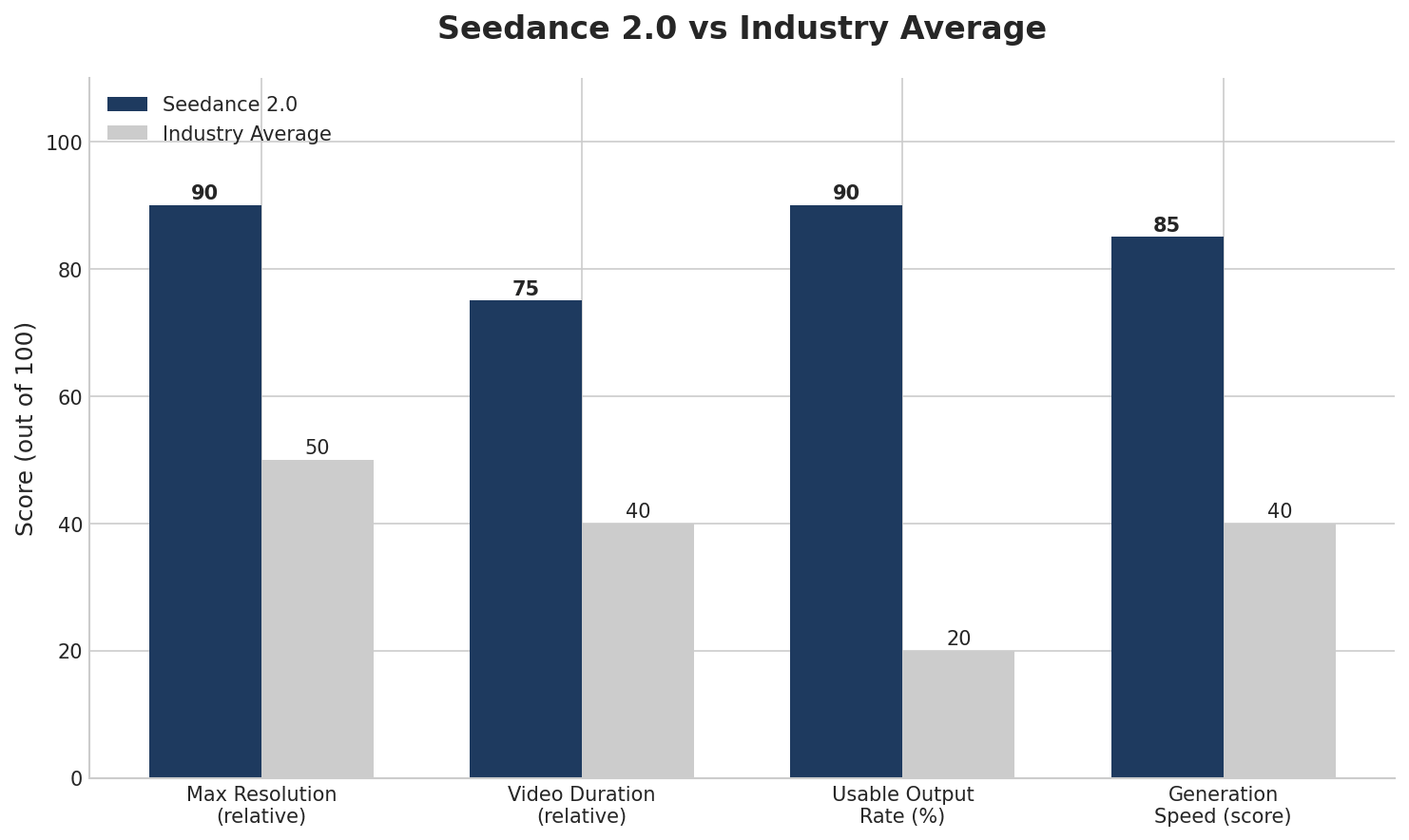
Data Sources: Redreamality
Seedance 2.0 leads on every metric, but the usable output rate (90% vs 20% industry average) tells the real story. That's not incremental improvement—it's the difference between a tool you can rely on and one you keep hoping will work. Resolution and speed matter, but consistent results matter more in production.
Seedance Cost Statistics & Value Metrics
1 API Pricing Metrics (USD/min)
Seedance 2.0 currently has No API available for external access. The model is accessible through ByteDance's platforms including Douyin (TikTok), Jiemian AI, and Volcano Engine, and other official platforms such as LumeFlow AI.
| Seedance Model | T2V ELO | API Price (USD/min) |
|---|---|---|
| Seedance 2.0 720p | 1,270 (#2) | No API available |
| Seedance 1.5 Pro | 1,173 (#29) | $5.93/min |
| Seedance 1.0 | 1,137 (#35) | $7.32/min |
| Seedance 1.0 Mini | 1,076 (#46) | $2.22/min |
Data Sources: Artificial Analysis
2 Value Analysis by Cost-per-ELO
The AI video space has gotten crowded. Seedance competes directly with Kling AI (Kuaishou), Runway ML, Google's Veo, and others. One significant shift recently: OpenAI announced Sora's discontinuation. The app shuts down April 26, 2026, with the API following on September 24, 2026.

Data Sources: Redreamality | Sora | KlingAI
The pricing data shows Seedance sitting in the middle of the pack—$9.6/month puts it above budget options like Veo 3 ($6) and Kling ($7), but well below premium tools like Sora ($20) and Runway ($12). That's a deliberate positioning: competitive enough to win over price-conscious users put off by Sora's cost, while avoiding the race-to-the-bottom with the cheapest alternatives. For a tool marketed as production-ready, the $9.6 price point signals quality without the premium tax.
Price Comparison (per minute):
| Model | Price (USD/min) | ELO Score | Value Score |
|---|---|---|---|
| Seedance 1.0 Mini | $2.22 | 1,076 | 484.7 |
| Seedance 1.5 Pro | $5.93 | 1,173 | 197.8 |
| Seedance 1.0 | $7.32 | 1,137 | 155.3 |
| Hailuo 2.3 (MiniMax) | $2.80 | 1,178 | 420.7 |
| LTX-2 Fast | $2.40 | 1,128 | 470.0 |
| Kling 2.6 Pro | $4.20 | 1,195 | 284.5 |
| Veo 3.1 Fast | $6.00 | 1,206 | 201.0 |
| Sora 2 | $6.00 | 1,185 | 197.5 |
| Kling 3.0 Pro | $13.44 | 1,248 | 92.9 |
| Veo 2 | $30.00 | 1,122 | 37.4 |
Data Sources: Artificial Analysis
Seedance 1.0 Mini offers the best absolute cost at $2.22/min, while Seedance 1.5 Pro provides the best balance of quality and cost for professional content production. At scale (100 ten-second videos), Seedance 1.5 Pro costs $47 compared to $95 for Kling 3.0 Pro—saving 50% on production costs.
3 E-commerce ROI Statistics

Data Sources: Atlas Cloud
Seedance drastically reduces production costs, making AI video marketing campaigns viable for smaller teams or solo creators. 1450% ROI boost, 80% sales increase, 73% conversion lift, and 90% cost reduction compared to traditional methods. The cost reduction metric is actually more practical—production costs dropping to roughly 10% of baseline explains where that ROI comes from. Seedance lets e-commerce teams produce more content faster, at lower cost, with better results. For marketing-focused buyers, this is the slide that seals the pitch.
Seedance Use Case Statistics & Application Data

Data Sources: 36Kr
Commercial ads and live-action drama represent Seedance's sweet spot—both high disruption potential and strong commercial value. E-commerce shorts score similarly on disruption but punch harder commercially, which tells you something: the market wants fast-turnaround content.
2D animation sits in an awkward spot—AI can handle the grunt work, but the task itself carries thin margins. Variety shows and education rank lowest on both fronts, probably because unpredictable workflows don't play well with templated generation.
Data Integrity: Copyright & Safety Considerations
No assessment of AI video tools would be complete without addressing the legitimate concerns in this space. Copyright and content safety issues deserve careful attention.
1 Copyright Questions
Investigative reporting has highlighted growing concerns that ByteDance's AI model, Seedance 2.0, may generate content that incorporates or resembles copyrighted material without authorization. According to The Hollywood Reporter, the Motion Picture Association described the system as exhibiting "systemic infringement", raising alarms across the entertainment industry.
The news has drawn attention across the entertainment industry, and it also highlights some of the tricky questions that generative AI raises for copyright:
- 1️⃣ AI content ownership rights remain unclear across jurisdictions.
- 2️⃣ Training data origins often lack transparent documentation.
- 3️⃣ Output may closely mimic copyrighted artistic styles.
- 4️⃣ Audio watermarking and identification continues to evolve.
Disney Hits ByteDance With Cease-and-Desist, Claiming Seedance AI Tool Is Hijacking Trademarked Characters
by u/MarvelsGrantMan136 in movies
2 Safety Measures
On the safety side, ByteDance has implemented several features:
- 1️⃣ Prompt filtering for harmful requests
- 2️⃣ Invisible watermarks in generated content
- 3️⃣ Age restrictions for mature content
- 4️⃣ Safeguards against impersonation misuse
These measures aren't perfect, but they represent a baseline effort. The watermarks won't stop someone determined to strip them, and prompt filters can be worked around. But they do provide a paper trail if something goes wrong, which matters more if you're generating content for clients or public-facing projects.
Tried to see if the Matrix style camera rig can be set up for a different shot using Seedance 2.0
— Morph (@Morph_VGart) February 24, 2026
made w/ @YouArtStudio pic.twitter.com/VtNr6t73KB
Market Data: Future Outlook for Seedance
Where is all this heading? Projections paint a picture of continued expansion.
Market Forecasts
| Projection | Value |
|---|---|
| Market size (2028) | $52 billion |
| Online video with AI (2030) | 90% |
| AI social video (2028) | 35% (from 11% today) |
| AI video platform users (2029) | 500 million |
| E-commerce AI personalization (2028) | 60% of brands |
| Daily AI video watched (2030) | 1 billion hours |
Data Sources: Vivideo
Looking ahead, AI video generation is scaling from experiment to infrastructure. With the market projected to hit $52 billion by 2028 and daily viewing hours reaching 1 billion by 2030, the competitive window is narrowing. The Seedance AI statistics compiled in this report confirm that ByteDance has moved beyond early experimentation into measurable, benchmarked performance.
The benchmark data tells a consistent story: Seedance 2.0 ranks #2 globally on ELO scores, delivers a 90% usable output rate, and offers competitive cost-per-minute metrics across both text-to-video and image-to-video tasks. ByteDance's reported $14 billion investment in Nvidia AI chips for 2026 signals continued scaling of these generative capabilities. For teams evaluating AI video generator benchmarks and seeking reliable performance data, the numbers position Seedance as a substantiated option for 2026.
Methodology & Data Sources
The Seedance AI statistics and performance benchmarks in this report were compiled using the following methodology:
- Third-party benchmark data: ELO rankings and performance scores were sourced from Artificial Analysis Video Arena, an independent benchmarking platform. All competitive data was accessed in April 2026.
- Official technical specifications: Resolution, multimodal input limits, and generation parameters were verified against ByteDance's official Seedance 2.0 documentation.
- E-commerce ROI statistics: Marketing performance data was referenced from AtlasCloud's 2026 e-commerce video generation study.
- Original data visualizations: All charts, comparison tables, and infographics in this report were produced by the LumeFlow AI team based on the above datasets.